
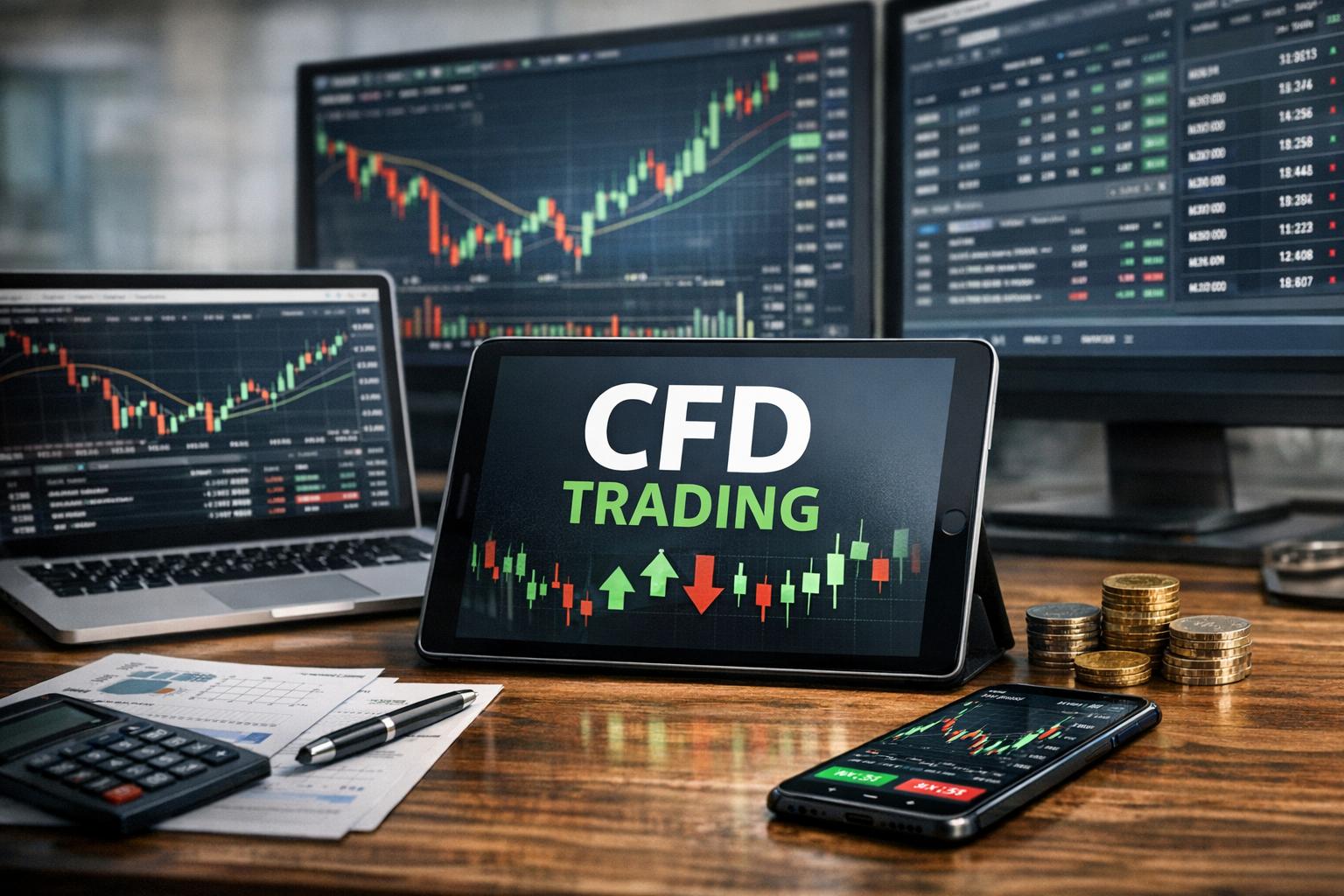
Contracts for Difference (CFDs) are financial derivatives that enable traders to speculate on price movements of underlying assets without acquiring ownership of those assets. Since their introduction in the United Kingdom during the 1990s, CFDs have expanded into numerous global markets and are now offered by brokers across Europe, Asia-Pacific, the Middle East, and other regions, subject to local regulation. The instrument is used by both retail and professional participants for speculative trading, tactical hedging, and portfolio diversification.
At their core, CFDs are structured to replicate the price performance of an underlying asset. Rather than transferring ownership, the contract settles the difference between the opening and closing price of the position. This structural distinction separates CFDs from traditional share dealing or commodity ownership and shapes their cost framework, risk profile, and regulatory treatment.
Structure and Mechanism of CFDs
A CFD is a bilateral agreement between a trader and a broker. When a position is opened, the contract records the price of the underlying asset. Upon closing the trade, the difference between the opening and closing price is calculated. If the price has moved in the trader’s favor, the broker pays the trader the net difference. If the market has moved against the trader, the trader pays the broker.
The underlying asset may be a publicly listed share, a stock market index, a commodity futures contract, a foreign exchange pair, a government bond yield, or a cryptocurrency price. Although the CFD tracks the performance of the chosen instrument, the trader does not receive shareholder voting rights, physical delivery of commodities, or entitlement to direct asset custody.
Positions can be opened as long positions, where the trader anticipates a price increase, or as short positions, where the trader anticipates a decline. The mechanics of going short are simplified compared to traditional markets. In conventional share trading, selling short may require borrowing shares. With CFDs, short exposure is created contractually, without the need for physical borrowing.
The pricing of CFDs generally mirrors the bid and ask prices of the underlying market, with adjustments determined by the broker’s pricing model. Corporate actions, such as dividend payments or stock splits, are typically reflected through account adjustments to maintain price continuity and economic equivalence.
Leverage and Margin
Leverage is a defining element of CFD trading. It allows traders to obtain exposure to a large notional position by committing only a fraction of its value as collateral. This initial deposit is known as the initial margin. The ratio between total exposure and required capital defines the leverage level.
For example, if leverage is set at 10:1, a trader depositing $2,000 can control a $20,000 position. A 5% movement in the underlying asset would translate into a 50% gain or loss on the deposited capital, excluding transaction costs. This mathematical amplification explains both the appeal and the elevated risk of leveraged trading.
In addition to initial margin, traders must maintain a maintenance margin. If market losses reduce account equity below this threshold, a margin call may occur. The broker can request additional funds or automatically close positions to prevent further losses. The speed at which margin levels can deteriorate during volatile market conditions is a core operational risk.
Regulators frequently impose leverage caps for retail clients. These limits differ by asset class, reflecting variations in historical volatility and liquidity. Major currency pairs generally carry lower margin requirements than individual equities or cryptocurrencies. Professional clients may access higher leverage, though eligibility criteria often include financial experience and portfolio size.
Many jurisdictions mandate negative balance protection for retail traders. Under this framework, losses cannot exceed the funds deposited in the account. This safeguard reduces catastrophic liabilities but does not eliminate the possibility of rapid and substantial capital depletion.
Pricing, Spreads, and Execution Models
CFD pricing is derived from the underlying market but may vary slightly depending on the broker’s liquidity sources and execution model. Brokers typically quote two prices: the bid, at which a trader can sell, and the ask, at which a trader can buy. The difference between these prices is known as the spread, which represents a primary transaction cost.
Some brokers operate as market makers, internalizing client orders and providing liquidity directly. Others employ straight-through processing or electronic communication network models, routing orders to external liquidity providers. Execution quality is influenced by latency, liquidity depth, and the broker’s technological infrastructure.
Slippage occurs when trades execute at a different price than requested. This may arise during high-volatility events or periods of low liquidity. Positive slippage can benefit traders, while negative slippage increases effective trading costs. Transparent order execution policies and detailed transaction reporting contribute to evaluating broker performance.
Markets Available for CFD Trading
One of the structural attractions of CFDs is broad market access through a single trading account. Equity CFDs allow exposure to individual companies listed on global exchanges. Traders can speculate on price changes in technology firms, financial institutions, energy producers, or emerging market stocks without establishing custodial arrangements in multiple jurisdictions.
Index CFDs track composite benchmarks such as the S&P 500, FTSE 100, Nikkei 225, or DAX 40. Because indices represent aggregated market performance, they are often used to express macroeconomic or sector-wide views. Traders may also use index CFDs to hedge diversified share portfolios.
Commodity CFDs cover precious metals, industrial metals, energy products, and agricultural goods. Gold and crude oil are among the most actively traded instruments in this category. Instead of handling physical contracts or futures expiry schedules, the CFD framework simplifies directional speculation.
Foreign exchange CFDs constitute a significant portion of trading volume. Currency pairs such as EUR/USD, GBP/USD, and USD/JPY are traded around the clock during the business week. The high liquidity of major currency pairs contributes to relatively tight spreads under stable market conditions.
Cryptocurrency CFDs provide price exposure to digital assets without requiring private key management or exchange wallets. However, digital asset markets can exhibit sharp volatility, leading to higher margin requirements and execution risks.
Costs and Financing
Transaction costs in CFD trading extend beyond spreads. Some brokers charge explicit commissions, particularly for share CFDs. Commission structures may be volume-based or fixed per contract.
Positions held beyond the trading day are generally subject to overnight financing fees. Because leveraged exposure effectively involves borrowing capital, financing adjustments compensate the broker for funding costs. These charges can be positive or negative depending on interest rate differentials and whether the position is long or short.
For short-term traders who close positions within the same session, overnight financing may be irrelevant. However, multi-week or multi-month strategies are significantly affected by cumulative financing costs. This feature distinguishes CFDs from unleveraged asset ownership.
Additional account-related charges may include inactivity fees, data subscription costs, or currency conversion spreads when trading assets denominated in foreign currencies. Evaluating total cost of trading requires analyzing all applicable components rather than focusing solely on advertised spreads.
Risk Factors in CFD Trading
CFDs are categorized as complex, high-risk instruments. Market volatility can lead to rapid shifts in unrealized profit and loss. Leveraged exposure intensifies sensitivity to price changes, meaning small fluctuations in the underlying asset translate into substantial capital variation.
Gap risk is prominent during major economic announcements, geopolitical events, or market openings following weekends. If prices jump from one level to another without trading at intermediate prices, stop-loss orders may execute at less favorable rates.
Because CFDs are generally traded over-the-counter, counterparty risk exists. The trader’s contractual relationship is with the broker rather than an exchange clearinghouse. Financial stability, regulatory compliance, and client fund segregation practices are therefore essential considerations in broker selection.
Liquidity risk may emerge when market depth declines. Spreads can widen, and order execution times may increase. High leverage combined with deteriorating liquidity can accelerate account drawdowns. These interrelated risk factors require continuous monitoring.
Regulatory Environment
CFD regulation differs significantly by jurisdiction. In the United Kingdom, oversight is conducted by the Financial Conduct Authority. Within the European Union, national regulators operate under the coordination framework of the European Securities and Markets Authority, which has introduced standardized leverage caps and marketing restrictions for retail clients.
Australia’s Australian Securities and Investments Commission applies leverage limits and product intervention measures. Other regions have adopted comparable safeguards, including mandatory risk warnings and standardized disclosure of retail loss percentages.
In contrast, certain countries restrict or prohibit retail CFD trading. In the United States, for example, retail investors typically access leveraged exposure through exchange-traded futures rather than OTC CFD contracts. These distinctions reflect differing regulatory philosophies concerning investor protection and market structure.
Trading Approaches and Strategic Use
CFDs are employed across a range of trading horizons. Intraday participants may focus on short-term volatility, using technical indicators, chart formations, and order flow analysis. Because leverage magnifies minor price movements, short-duration strategies can produce material gains or losses within hours.
Swing traders hold positions over several days or weeks, targeting broader price swings. This approach may combine technical analysis with macroeconomic or earnings-related insights. Financing costs and weekend gap exposure must be incorporated into planning.
CFDs can also function as hedging instruments. An investor with a diversified share portfolio might open a short index CFD to offset temporary downside risk. If the broader market declines, losses in the physical portfolio may be partially counterbalanced by gains in the derivative position.
Algorithmic systems participate in CFD markets through automated signal generation and execution. Such systems depend on historical data integrity, latency minimization, and disciplined parameter calibration. Automated trading does not eliminate risk; it changes the method by which decisions are implemented.
Risk Management Practices
Structured risk management is central to sustained participation in leveraged markets. Stop-loss orders are commonly used to define maximum acceptable losses on individual trades. Some brokers offer guaranteed stop mechanisms for a premium, ensuring execution at the specified level regardless of market gaps.
Position sizing determines how much capital is allocated to each trade relative to total account equity. Maintaining moderate exposure reduces the probability that a single adverse movement will impair the entire account. Quantitative frameworks often limit per-trade risk to a predefined percentage of available capital.
Diversification across asset classes and correlation management further moderates portfolio-level volatility. Continuous review of leverage utilization, cumulative open risk, and macroeconomic event calendars strengthens procedural discipline.
Technological Infrastructure
Modern CFD trading is conducted through digital platforms accessible via desktop applications, web interfaces, and mobile devices. Core platform components include real-time charting, integrated technical indicators, customizable order types, and account analytics dashboards.
Latency, uptime reliability, and cybersecurity protections are material infrastructure considerations. Encryption protocols and segregated client fund accounting systems reinforce operational resilience. For active traders, execution consistency during volatile periods can materially influence performance outcomes.
Tax Considerations
The taxation of CFD profits depends on jurisdictional rules and the trader’s classification. Gains may be treated as capital gains or ordinary income. Losses may be deductible, subject to local legislation. Because CFD trading can involve high transaction frequency, detailed record-keeping is essential for compliance.
Brokers typically provide account statements summarizing realized gains, losses, financing adjustments, and commissions. However, responsibility for accurate tax reporting rests with the individual or entity engaging in the activity.
Advantages of CFD Trading
CFDs provide streamlined access to a broad set of global markets from a unified platform. The ability to take both long and short positions with procedural simplicity enhances strategic flexibility. Leverage permits capital efficiency, enabling traders to allocate funds dynamically across multiple instruments.
Fractional position sizing allows granular exposure adjustments. Compared with certain exchange-traded derivatives, CFD contracts do not involve standardized lot sizes or fixed expiry dates, which can simplify position management for some participants.
Disadvantages and Structural Criticisms
High retail loss rates remain a significant concern. The interaction of leverage, volatility, and behavioral biases contributes to capital erosion among inexperienced traders. Financing costs reduce efficiency for extended holding periods, making CFDs less suitable for long-term investment strategies.
The OTC structure introduces potential conflicts of interest, particularly when brokers act as principal counterparties. Although reputable firms implement transparent pricing policies and compliance controls, structural counterparty dependence remains inherent in the model.
Suitability and Investor Profile
CFDs are generally appropriate for individuals or institutions with a clear understanding of leverage mechanics, margin processes, and market volatility. Regulatory frameworks often require appropriateness assessments prior to granting trading access. Educational materials and demonstration accounts assist users in understanding operational features before committing capital.
Participation in CFD markets requires disciplined risk management, continuous monitoring of open exposure, and evaluation of cost structures. While the instrument offers flexibility and broad market reach, its leveraged nature demands measured and informed application within a coherent trading or hedging strategy.