
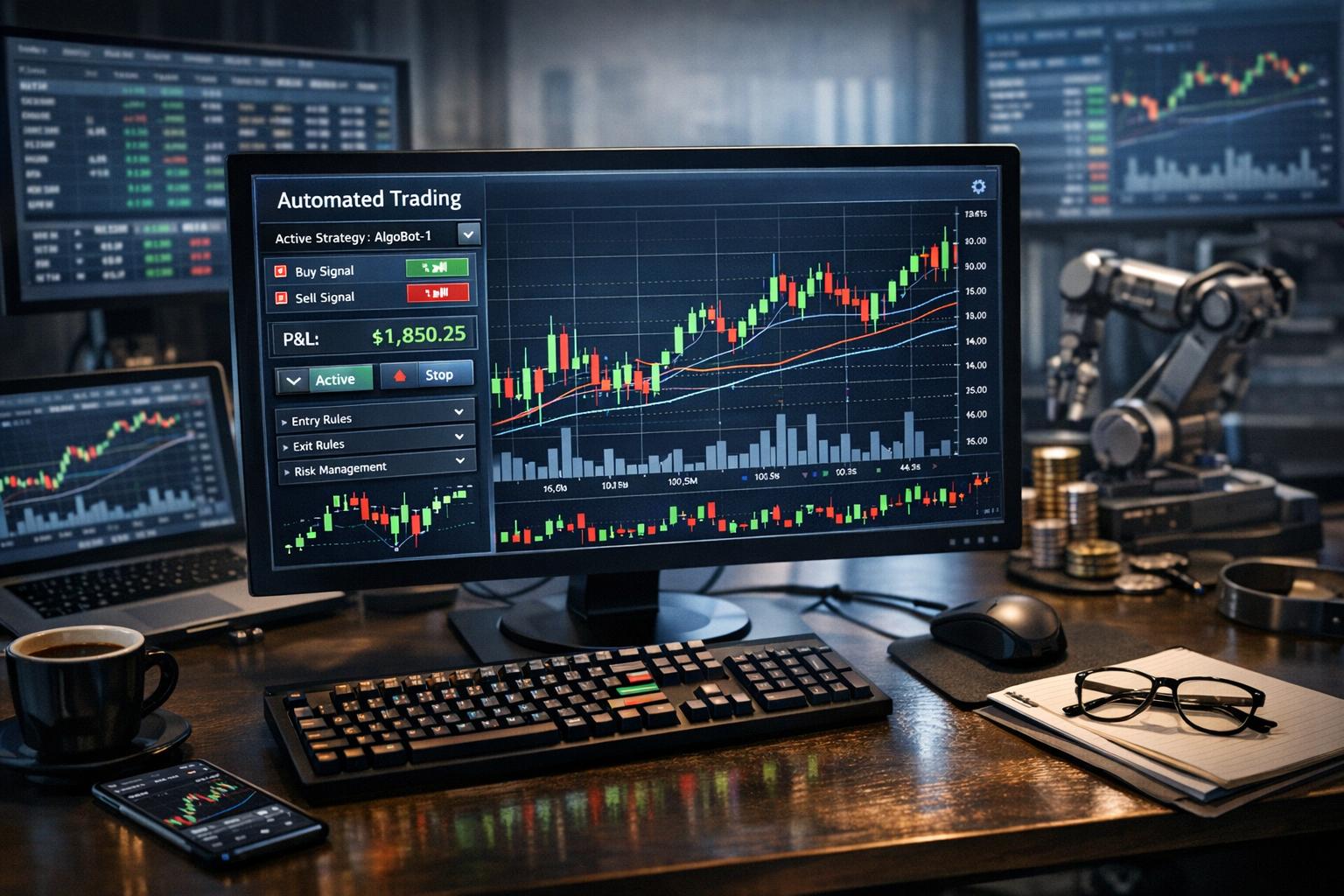
Automated trading refers to the use of computer programs and algorithms to execute financial market transactions with minimal or no human intervention. It has become a central component of modern financial markets, spanning asset classes such as equities, foreign exchange, commodities, derivatives, fixed income instruments, and cryptocurrencies. By combining predefined rules, mathematical models, and real-time market data, automated systems can identify opportunities and execute trades at speeds and frequencies that are not achievable through manual processes.
The development of automated trading is closely tied to advances in computing power, data storage, telecommunications, and electronic exchange infrastructure. As exchanges transitioned from open outcry systems to fully electronic order books, the opportunity to formalize and automate trading decisions expanded significantly. Today, a substantial portion of daily trading volume on major exchanges is generated by algorithmic systems rather than discretionary human traders. In many highly liquid markets, such as large-cap equities and foreign exchange, algorithm-driven activity represents the dominant share of order flow.
Core Concepts in Automated Trading
At its foundation, automated trading relies on the transformation of a trading strategy into explicit, programmable instructions. These instructions define entry and exit criteria, position sizing, capital allocation, and risk control parameters. The algorithm systematically monitors incoming data, evaluates whether conditions meet predefined thresholds, and submits orders to a broker or directly to an exchange when criteria are satisfied.
A complete automated trading framework typically includes multiple integrated components. The first layer consists of data acquisition, which may draw from exchange price feeds, level-two order book data, macroeconomic releases, corporate fundamentals, or alternative sources such as sentiment indicators. Data must be normalized, time-stamped, and validated for accuracy before being passed to subsequent modules.
Signal generation is the analytical core of the system. Here, mathematical formulas or statistical models translate raw data into actionable signals. These may include moving-average crossovers, cointegration regressions, volatility breakouts, or predictive outputs from supervised learning models. The system then applies risk management logic, which determines the maximum allowable position size, correlation exposure, and portfolio concentration.
Execution modules convert trading signals into actual market orders. This process involves selecting order types such as market, limit, stop, or algorithmic execution slices. Automated strategies must account for transaction costs, partial fills, and real-time liquidity conditions. In some cases, systems dynamically adjust limit prices in response to shifting bid-ask spreads.
Latency, defined as the time delay between receiving market data and transmitting a confirmed order, plays a critical role in certain categories of automated trading. In high-frequency environments, latency differences measured in microseconds can materially affect profitability. Firms invest in optimized hardware, low-level programming languages, and proximity hosting in exchange data centers to reduce delays. Conversely, longer-term systematic investors operating on hourly or daily time horizons face minimal sensitivity to ultra-low latency.
Market Microstructure and Execution Dynamics
Automated trading systems operate within the framework of modern market microstructure, which refers to the mechanics of how orders are matched and prices are formed. Most major exchanges use electronic limit order books in which participants submit bids and offers. Orders are typically matched based on price priority and then time priority.
Algorithmic strategies must account for queue position, hidden liquidity, and order fragmentation across multiple trading venues. In fragmented markets, a single security may trade simultaneously on several exchanges or alternative trading systems. Smart order routing algorithms evaluate venue-specific fees, rebates, and fill probabilities to determine optimal order placement.
Market impact represents a measurable cost associated with order execution. Large orders can shift prices unfavorably as other participants react. Automated execution algorithms attempt to mitigate this cost by slicing large trades into smaller increments distributed over time. Methods such as volume-weighted average price and implementation shortfall models estimate and control transaction expenses relative to benchmarks.
Historical Development
The origins of automated trading date to the introduction of early computerized financial models in the 1970s. Institutional investors began using program trading to execute baskets of stocks linked to equity index futures arbitrage. These early systems were limited by computing capacity and data availability, yet they marked the beginning of rule-based trade execution.
During the 1990s, electronic communication networks facilitated more direct interaction between market participants. Traders gained the ability to bypass traditional floor-based intermediaries and transmit orders electronically. As internet connectivity and standardized data protocols expanded, algorithmic trading became more accessible to a broader range of institutional firms.
The early 2000s saw rapid growth in high-frequency trading, characterized by short holding periods and high order turnover. Specialized firms invested heavily in co-location and custom hardware to minimize latency. At the same time, hedge funds and asset managers developed medium- and long-term quantitative strategies focused on factor investing, statistical arbitrage, and systematic macro models.
In the past decade, the integration of machine learning and distributed computing has further expanded analytical capabilities. Large-scale backtesting across decades of historical data, previously impractical, has become routine. Cloud infrastructure enables scalable processing, allowing complex simulations that evaluate thousands of parameter combinations.
Types of Automated Trading Strategies
Automated trading strategies vary significantly in structure and objective. Trend-following systems are designed to identify persistent price movements and align positions accordingly. These systems often incorporate trend filters, breakout thresholds, and volatility adjustments. Their effectiveness tends to rely on sustained market momentum rather than short-term oscillations.
Mean reversion strategies operate on the assumption that prices periodically revert to statistical averages. These approaches measure deviations from historical relationships, such as price-to-earnings ratios, yield spreads, or pairwise correlations between related securities. Entry signals are triggered when deviations exceed predefined thresholds, with exits occurring as spreads converge.
Market-making algorithms continuously post bid and ask quotes, seeking to capture the bid-ask spread while maintaining neutral inventory. Inventory risk management is central to this approach. When positions accumulate excessively on one side, pricing adjustments are made to attract offsetting flow.
Arbitrage strategies exploit temporary mispricings between related instruments. Examples include cash-and-carry arbitrage between futures and underlying assets, triangular currency arbitrage, and relative value trades among fixed income securities. Because inefficiencies are typically small and short-lived, efficient infrastructure and rapid data processing are essential.
Execution-focused systems represent another major category. These algorithms are used by institutional investors to implement investment decisions with minimal disruption. Rather than forecasting price movements, they concentrate on achieving benchmark prices while reducing information leakage.
Technical Infrastructure
The architecture of an automated trading platform encompasses hardware, software, and networking layers. Market data feeds provide continuous price updates that must be handled with high reliability and minimal delay. Data integrity checks identify missing or inconsistent values before signal generation begins.
Order management systems coordinate trade lifecycle events, including submission, modification, cancellation, and confirmation. These systems maintain synchronized records of open positions and margin requirements. Professional firms often deploy redundant servers and independent network routes to ensure operational continuity.
Programming language selection affects both performance and development efficiency. Lower-level languages such as C++ are frequently used in latency-sensitive contexts, while Python and similar languages are employed for research, prototyping, and machine learning implementation. Structured version control, continuous integration testing, and documented code reviews form part of disciplined development practices.
Backtesting evaluates strategy performance using historical data. Developers simulate trades over multiple market cycles, assessing drawdowns, volatility, and correlation patterns. Proper methodology requires separation between in-sample optimization and out-of-sample validation to mitigate overfitting. Walk-forward testing further enhances robustness by periodically recalibrating parameters on rolling windows.
Following backtesting, systems typically undergo simulation testing in real-time conditions without capital exposure. This stage verifies correct interaction with live data feeds and brokerage interfaces. Only after passing simulation benchmarks are strategies deployed with incremental capital allocations.
Risk Management and Controls
Risk management in automated trading operates at multiple levels. Strategy-level controls define maximum position sizes, leverage ratios, and stop-loss thresholds. Portfolio-level controls oversee aggregate exposure across correlated instruments and asset classes. Hard risk limits are generally embedded directly into system architecture to prevent breaches even if primary logic fails.
Daily loss limits restrict cumulative negative performance, triggering automatic deactivation if thresholds are exceeded. Exposure caps by sector, geography, or volatility regime prevent excessive concentration. Systems may incorporate dynamic volatility scaling, reducing position size during periods of heightened market turbulence.
Stress testing models extreme but plausible market scenarios. Historical crises such as abrupt currency devaluations or equity crashes provide empirical data for scenario construction. Synthetic shock simulations, including sudden liquidity withdrawal or widened spreads, test resilience against rare disruptions.
Operational controls are equally critical. Monitoring dashboards track latency, order rejection rates, and connectivity status. Logging mechanisms record every system action, enabling forensic review if anomalies occur. Manual override capabilities permit immediate suspension of trading in the event of unexpected behavior.
Regulatory Environment
Regulatory oversight of automated trading has evolved alongside its expansion. Authorities commonly require pre-trade risk checks to ensure that orders remain within capital and exposure limits. Automated kill switches must allow rapid shutdown under specified conditions.
Regulations often mandate detailed audit trails documenting order initiation, modification, and cancellation times. These records assist in market surveillance and reconstruction of events during volatility incidents. Exchanges enforce circuit breakers that pause trading when price moves exceed predefined percentages.
Supervisory bodies may also monitor order-to-trade ratios to discourage excessive message traffic that could strain exchange infrastructure. Participants engaged in algorithmic trading typically must maintain documented policies covering development standards, monitoring practices, and incident response protocols.
Advantages of Automated Trading
Automated trading offers structural efficiency derived from rule-based execution. Algorithms apply predetermined criteria consistently, reducing deviations from defined methodology. The ability to monitor numerous assets simultaneously enhances diversification potential and analytical breadth.
Scalability represents another benefit. Once developed and validated, a strategy can often be extended to additional instruments or markets with incremental adjustments. Speed of response allows rapid incorporation of publicly available information into pricing decisions.
Systematic implementation also enables precise performance measurement. Because decisions follow coded instructions, results can be decomposed into identifiable drivers such as signal quality, execution cost, and risk allocation efficiency.
Limitations and Challenges
Despite structural efficiencies, automated trading carries substantive limitations. Model risk arises when underlying assumptions diverge from actual market behavior. Structural market changes, evolving participant composition, or regulatory shifts may erode previously profitable relationships.
Over-optimization during development can produce fragile strategies that perform well in historical simulations but degrade in live trading. Robust validation frameworks are required to reduce curve-fitting tendencies. Data quality issues, including survivorship bias and inaccurate timestamps, can further distort results.
Technical vulnerabilities must be addressed through cybersecurity safeguards, hardware redundancy, and disciplined release management. Competitive pressures also compress margins as similar quantitative techniques become widely adopted. In highly efficient markets, excess returns may diminish over time.
Transaction costs, including slippage and exchange fees, materially affect net performance. High-turnover strategies are particularly sensitive to marginal cost increases. Continuous measurement and refinement of execution efficiency remain essential.
Role of Machine Learning and Artificial Intelligence
Machine learning techniques have expanded the analytical scope of automated trading by enabling pattern recognition across complex, high-dimensional datasets. Supervised learning models classify or predict price movements based on historical labeled examples. Unsupervised learning methods identify latent structures or clustering patterns within financial data.
Reinforcement learning frameworks allow adaptive optimization of trading policies through iterative interaction with simulated environments. Neural networks can approximate nonlinear relationships that traditional linear models may not capture effectively.
However, these methods demand careful validation and interpretability controls. Large datasets may contain noise and non-stationary properties. Without rigorous regularization and cross-validation, models risk capturing spurious correlations. Consequently, many firms integrate machine learning components within broader, transparent risk frameworks rather than deploying fully opaque systems.
Application Across Asset Classes
Automated trading operates across nearly all liquid markets. In foreign exchange, continuous 24-hour trading supports algorithmic execution around global sessions. Equity markets employ systematic strategies for factor-based investing, index replication, and intraday liquidity provision.
Fixed income markets increasingly incorporate electronic trading platforms, enabling automated pricing of government and corporate bonds. Commodity and energy markets rely on algorithmic hedging models that incorporate production forecasts and macroeconomic variables.
Cryptocurrency markets, characterized by fragmented exchanges and continuous trading cycles, have experienced rapid adoption of automated systems. Differences in exchange liquidity and pricing create arbitrage and market-making opportunities suited to algorithmic implementation.
Institutional investors use automated execution tools to rebalance portfolios efficiently and manage cash flows. Retail market participants increasingly access simplified algorithmic interfaces through brokerage platforms, though infrastructure capabilities and risk controls may differ substantially from institutional standards.
Future Outlook
The long-term evolution of automated trading is closely connected to advancements in computational hardware, distributed systems, and data analytics. Improvements in processing speed and storage efficiency enable broader exploration of complex models. Expanded alternative data sources, including satellite imagery and transactional datasets, may contribute to diversified signal development.
Regulatory frameworks are likely to continue evolving in response to technological innovation. Standardized testing procedures, enhanced transparency requirements, and harmonized cross-border rules may shape the competitive landscape. Market participants will need to balance innovation with stability and compliance considerations.
In aggregate, automated trading reflects the increasing integration of quantitative research, software engineering, and financial theory. It has reshaped market structure, liquidity dynamics, and execution methodology across asset classes. While it introduces new categories of model and operational risk, disciplined governance and technological resilience enable systematic participation in global financial markets.