
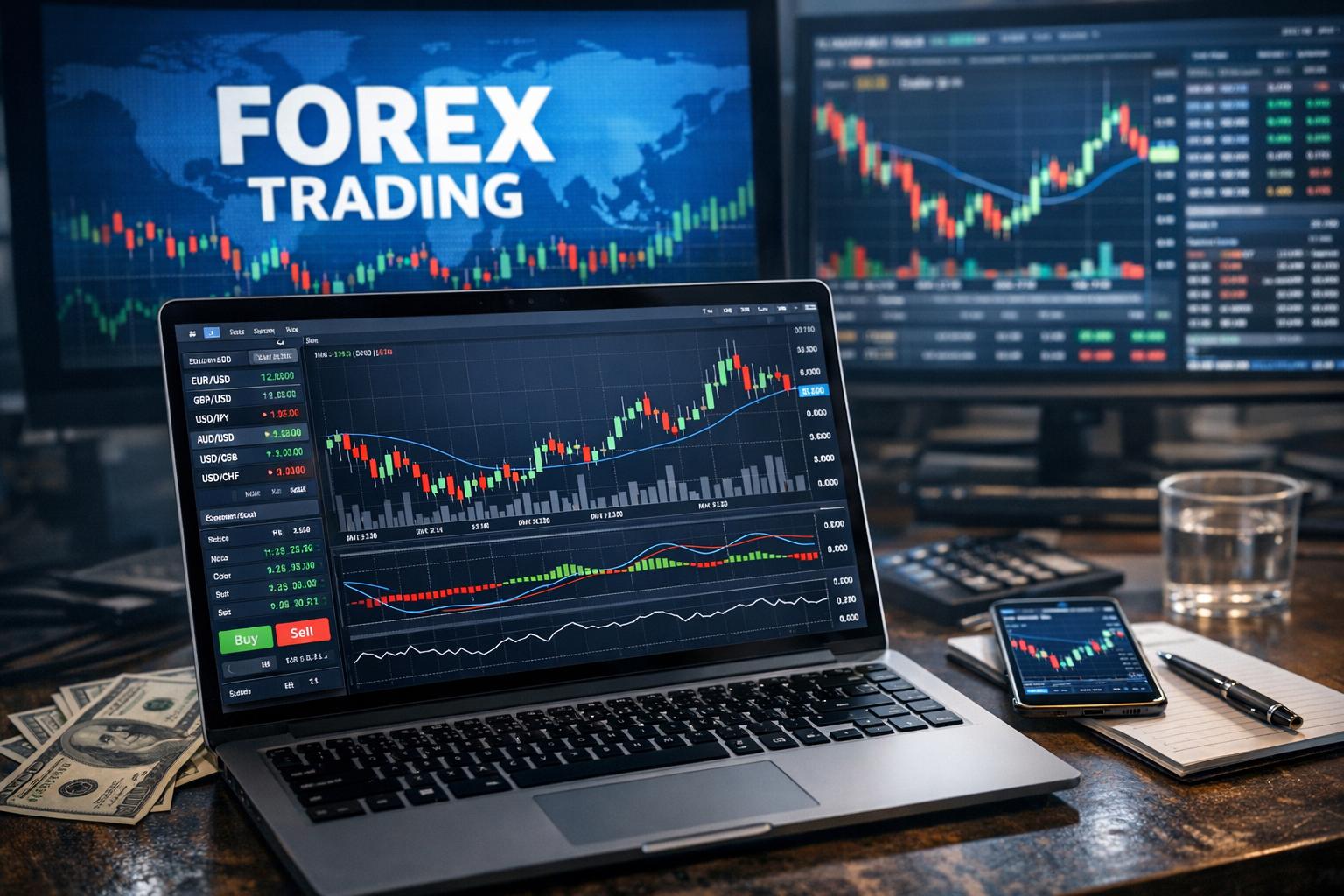
Overview of the Foreign Exchange Market
The foreign exchange market, commonly referred to as Forex or FX, is a decentralized global marketplace where currencies are traded against one another. It represents the foundational infrastructure that allows one nation’s currency to be converted into another, thereby enabling international economic interaction. With average daily trading volumes measured in trillions of U.S. dollars, it surpasses all other financial markets in scale and liquidity. Unlike centralized stock exchanges that operate from a physical location, the Forex market functions through a distributed electronic network connecting banks, financial institutions, brokers, corporations, governments, and individual traders.
The fundamental purpose of the market is currency conversion. Businesses engaged in cross-border trade must exchange currencies to pay for goods and services. Investors purchasing foreign assets require access to local currencies. Tourists traveling internationally exchange funds for spending abroad. These routine activities create continuous demand for currency transactions. Beyond its commercial role, the market also facilitates speculative trading, capital hedging, risk transfer, and strategic asset allocation. As a result, Forex stands at the intersection of commerce, finance, and macroeconomic policy.
The scope of the foreign exchange market is truly global. Trading begins as financial markets open in the Asia-Pacific region and continues through Europe and North America before cycling back again. Because currencies are central to all cross-border transactions, the market operates as an essential component of international economic integration.
Structure of the Forex Market
The Forex market operates 24 hours a day, five days a week, reflecting the continuous overlap of major global financial centers. Activity typically follows the trading sessions of Sydney, Tokyo, London, and New York. When one center closes, another remains open, allowing trading to continue without interruption during weekdays. This near-continuous cycle contributes to deep liquidity, especially in widely traded currency pairs.
Forex trading occurs over the counter (OTC), meaning that transactions take place directly between participants through electronic communication networks rather than on a centralized exchange. Prices are determined by supply and demand across this vast interbank network. Major international banks quote bid and ask prices to one another, forming what is commonly described as the interbank market. Retail brokers aggregate these prices and provide access to individual traders.
The absence of a single centralized exchange does not imply a lack of structure. Instead, the market operates through a hierarchy. Large financial institutions transact at the top tier, benefiting from tight spreads due to high volumes and established credit relationships. Smaller institutions and retail participants access liquidity indirectly through brokerage firms. Technological advancements have improved transparency and efficiency, narrowing pricing discrepancies across providers.
Spot, Forward, and Futures Markets
The Forex market is commonly divided into three primary segments: the spot market, the forward market, and the futures market. The spot market involves the immediate exchange of currencies at the current market rate, typically settled within two business days. Most retail and short-term trading activity occurs in this segment.
The forward market allows participants to agree on an exchange rate for a transaction that will occur at a future date. These contracts are customizable agreements between counterparties and are frequently used by corporations to hedge exposure to exchange rate fluctuations. The futures market, in contrast, involves standardized contracts traded on organized exchanges. Currency futures specify a fixed contract size and settlement date, providing transparency and centralized clearing mechanisms.
While retail traders primarily interact with spot markets through brokers, institutional participants frequently utilize forwards and futures for hedging and risk management. Together, these segments create a comprehensive framework for both immediate trading and longer-term currency exposure management.
Currency Pairs and Quotation
Currencies are traded in pairs, representing the relative value of one currency compared with another. Each pair consists of a base currency and a quote currency. When a trader purchases a currency pair, they are simultaneously buying the base currency and selling the quote currency. For example, in EUR/USD at 1.1000, one euro is valued at 1.10 U.S. dollars.
Pairs are broadly categorized into major pairs, minor pairs, and exotic pairs. Major pairs include the most actively traded currencies globally, often involving the U.S. dollar due to its central role in global finance. Minor pairs exclude the U.S. dollar but involve other significant currencies such as the euro, British pound, Japanese yen, or Australian dollar. Exotic pairs match a major currency with one from a smaller or emerging economy. These tend to exhibit lower liquidity and wider spreads.
Exchange rates are typically quoted to four or five decimal places. A small unit of price movement is referred to as a pip, representing the standard increment of change in a currency pair’s value. Understanding pips and lot sizes is essential for calculating potential profit and loss in trading positions.
Bid, Ask, and Spread
Every Forex quote displays a bid price and an ask price. The bid is the highest price a buyer is willing to pay, while the ask is the lowest price a seller will accept. The difference between these two prices is known as the spread. For highly liquid pairs, spreads are typically narrow due to intense competition among liquidity providers. In periods of heightened volatility or lower liquidity, spreads can widen.
For many brokers, the spread represents a primary source of compensation. Some brokerage models also incorporate commissions per trade. Pricing models vary depending on whether the broker operates as a market maker or provides direct market access through an agency model.
Market Participants and Their Roles
The Forex market consists of diverse participants, each engaging for distinct purposes. At the institutional level, major commercial and investment banks execute large transactions that form the backbone of global liquidity. Their trading activity may serve clients, manage risk exposure, or support proprietary strategies.
Central banks are key actors in currency markets. Their primary responsibilities include implementing monetary policy, maintaining price stability, and supporting economic growth. Adjustments to benchmark interest rates, asset purchase programs, and other policy tools directly influence exchange rates. On occasion, central banks intervene directly in the currency market to stabilize their national currency or counter disorderly movements.
Multinational corporations participate to hedge revenue and expense exposure denominated in foreign currencies. A firm that earns income abroad but reports financial statements in its domestic currency faces exchange rate risk. Forward contracts and other instruments help mitigate this exposure.
Hedge funds and investment managers approach the market from a return-seeking perspective. Their strategies may involve macroeconomic forecasting, interest rate differentials, or cross-asset positioning. Because of their capital resources, large institutional investors can significantly influence short-term market movements.
Retail traders, enabled by online brokerage platforms, represent a growing segment of the market. Though individual transaction sizes are relatively small, the aggregate activity of retail traders contributes to overall liquidity and market diversity.
Factors Influencing Exchange Rates
Exchange rates fluctuate in response to a combination of economic data, financial flows, political developments, and market expectations. Among the most influential drivers are macroeconomic indicators such as gross domestic product (GDP), inflation metrics, and employment statistics. Strong economic data can support a currency by signaling robust growth potential, whereas weaker data may reduce investor confidence.
Interest rates play a central role in currency valuation. When a country offers relatively higher interest rates, its financial assets may become more attractive to foreign investors seeking yield. This increased demand can strengthen the currency. Conversely, lower interest rates may reduce inflows and exert downward pressure on exchange rates.
Another significant factor is inflation. If inflation rises without corresponding monetary tightening, a currency may depreciate due to eroding purchasing power. Central bank credibility in managing inflation therefore becomes critical in sustaining currency stability.
Political stability and governance influence investor perception of risk. Elections, fiscal policy debates, trade negotiations, and geopolitical tensions introduce uncertainty that may redirect capital flows. In times of global uncertainty, investors often gravitate toward currencies perceived as safe havens, including the U.S. dollar, Swiss franc, or Japanese yen.
Market psychology also contributes to short-term fluctuations. Expectations regarding future policy decisions or economic performance can be priced into exchange rates well before official announcements are released. As a result, currency markets often react not only to actual data but also to deviations from consensus forecasts.
Trading Mechanisms and Order Types
Electronic trading platforms provide the primary interface between traders and the Forex market. These platforms deliver real-time pricing, charting tools, analytical indicators, and order execution capabilities. Traders select position sizes measured in standardized units called lots, which define the scale of exposure.
A market order executes immediately at the best available price. A limit order specifies a particular entry or exit level and executes only if the market reaches that price. A stop order activates when the market touches a predefined level, often serving as a protective mechanism against adverse price movements. Combinations such as stop-loss and take-profit orders enable structured trade management.
Leverage is a defining characteristic of Forex trading. By depositing a margin, traders can control positions larger than their actual capital. While leverage enhances capital efficiency, it proportionally increases risk exposure. Regulatory bodies in many jurisdictions impose limits on maximum leverage to protect retail traders from excessive losses.
Risk Management in Forex Trading
Effective risk management underpins long-term viability in currency trading. Given the potential for rapid price movements, unmanaged positions can result in substantial losses. Traders commonly utilize stop-loss orders to limit downside exposure and define acceptable risk before entering a position.
Position sizing is another essential discipline. Allocating only a measured proportion of account equity to each trade reduces the impact of adverse outcomes. Margin requirements should be monitored carefully, particularly when leverage is employed. If equity falls below maintenance thresholds, brokers may initiate a margin call or liquidate open positions.
Correlation between currency pairs also warrants consideration. Because certain currencies demonstrate interconnected movements, diversification across pairs may not always reduce risk as expected. A comprehensive understanding of exposure across trades helps prevent unintended concentration.
Technical and Fundamental Analysis
Technical analysis examines historical price data to identify recurring patterns and trends. Traders employ indicators such as moving averages, oscillators, and momentum metrics to evaluate market direction. Chart formations, including trendlines and support and resistance levels, assist in determining potential entry and exit points.
Fundamental analysis emphasizes economic conditions, interest rate expectations, and policy developments. By evaluating central bank statements, fiscal indicators, and geopolitical events, traders seek to assess whether a currency is likely to appreciate or depreciate over a given horizon.
Many participants integrate both approaches. For example, a trader may form a directional view based on interest rate differentials while relying on technical signals to optimize trade timing. The balance between these methodologies varies depending on whether the strategy is short-term or long-term in nature.
Regulation and Broker Selection
Although decentralized, the Forex market is subject to regulatory oversight at the national level. Authorities such as the Commodity Futures Trading Commission (CFTC), the Financial Conduct Authority (FCA), and the Australian Securities and Investments Commission (ASIC) establish standards designed to protect market participants and promote transparency.
Regulated brokers are typically required to maintain segregated client accounts, meet capital adequacy requirements, and provide clear disclosures regarding pricing and risk. When selecting a broker, traders often evaluate regulatory status, fee structures, execution methods, platform functionality, and customer service reliability.
Broker models vary. Some operate as market makers, quoting prices internally and assuming counterparty risk. Others provide agency-style access to liquidity pools. Understanding the operational framework assists traders in assessing potential conflicts of interest and execution quality.
Technological Developments in Forex
Technological progress has reshaped the Forex landscape. Electronic communication networks have reduced transaction costs and improved execution speed. Algorithmic trading systems enable the automated execution of predefined strategies, including high-frequency trading approaches employed by institutional participants.
Retail platforms now incorporate advanced charting tools, integrated news feeds, and automated strategy testing environments. Mobile applications allow continuous monitoring of positions across devices. These advancements have made the market more accessible while simultaneously increasing competition.
Despite improvements, reliance on digital infrastructure introduces operational considerations. Connectivity disruptions, cybersecurity risks, and system failures represent potential vulnerabilities. Brokers and traders alike must prioritize secure systems and contingency planning.
Advantages and Limitations of Forex Trading
The Forex market offers structural advantages, including high liquidity in major currency pairs and continuous weekday trading hours. These factors typically enable rapid execution and flexible participation. The ability to trade both rising and falling markets further expands strategic possibilities.
However, limitations are inherent. Leverage magnifies exposure to losses as well as gains. Market movements can be sharp during periods of economic announcements or geopolitical developments. Additionally, pricing may vary slightly across brokers due to the decentralized structure of the market.
A measured approach that emphasizes risk control, strategic discipline, and regulatory awareness is fundamental to navigating these conditions effectively.
Conclusion
The Forex market functions as an essential mechanism within the global financial system, facilitating currency exchange for trade, investment, policy implementation, and speculation. Its decentralized architecture, global participation, and substantial liquidity distinguish it from other financial markets. Exchange rates are shaped by economic data, interest rate differentials, political developments, and collective market expectations.
Engaging in Forex trading requires comprehension of currency pair dynamics, order execution methods, and leverage implications. Both technical and fundamental analyses contribute to structured decision-making, while disciplined risk management remains central to preserving capital. Regulatory oversight and technological infrastructure further define the trading environment.
The foreign exchange market continues to evolve alongside global economic integration and technological innovation. Participants who approach it with analytical rigor, operational awareness, and prudent risk control are better positioned to navigate its complexities within an interconnected financial landscape.